1
min read
How many systems did you open today?
Your software didn't get integrated, you did, and the price is hours of switching between systems every day, decisions made with incomplete information, and duplicated work no dashboard will ever show you.

Every system in your stack got added for a good reason. Then another came, and another. None of them talk to each other, so you became the integration layer: the human who remembers which tool to check first for which kind of task.
The cost shows up as days that felt busy and produced very little, as decisions made with quiet doubt, and as work rebuilt because nobody could find what already existed.
The integration layer between your own systems
Let's envision a meeting you've probably had. The calendar entry says "quarterly review." Nothing else.
What do you actually need to show up prepared?
The notes from your last conversation, wherever those ended up
The email thread where the customer raised a concern about pricing
Their open support tickets
The last invoice, and whether it was paid on time
The renewal date in the contract
What was promised in the original proposal
Whether a colleague has spoken to them more recently than you have
All of it exists. None of it in the same place.
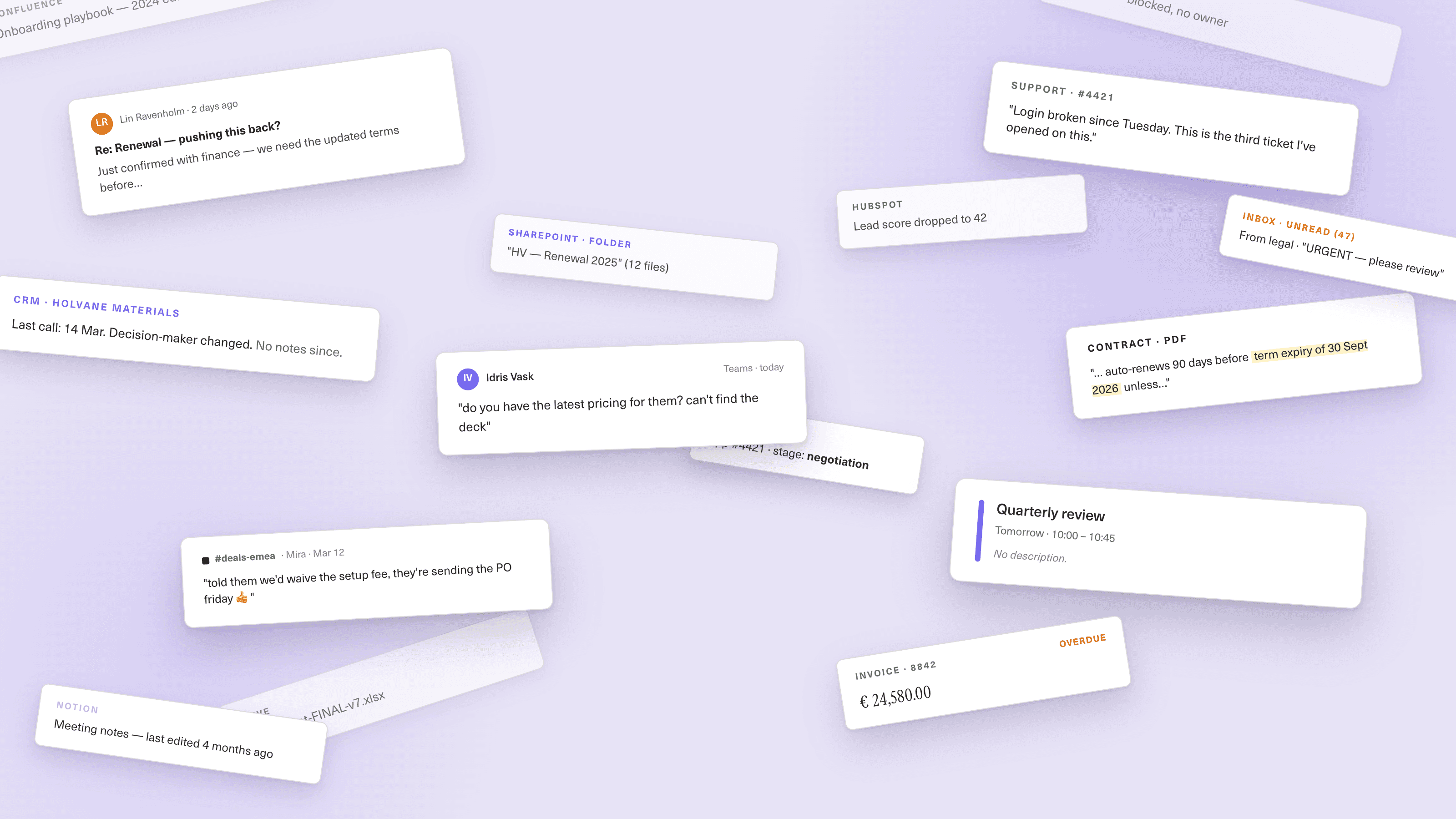
The four-system problem
Your CRM has part of it. Your inbox has another part. Your ERP has the invoice. Your contract system has the terms. Your colleague has the rest, and they're in another meeting.
That's four systems, and you haven't started the actual work yet.
You spend thirty minutes you don't have piecing it together. You walk in anyway, unsure whether you have the full picture.
Employees spend hours per day searching for information, and nearly half the time, what they find is wrong or incomplete.
Sound familiar?
Four costs you're already paying
Cost | What it actually looks like |
|---|---|
Time | The hours don't show up on a dashboard. They show up as a day that felt busy and produced very little. Employees often don't have enough uninterrupted focus time, with searching and switching between apps among the top causes |
Confidence | When what you need comes from five different places, you're never quite sure it's complete. You make the call anyway. But that small doubt follows every decision |
Risk | A compliance question handled from memory. A commitment made without checking what you'd already agreed to. A reply sent before you found the email that would have changed it |
Duplicated work | Right now, someone in your company is rebuilding a template, a proposal, or a process that already exists in a folder they can't find. That's paying twice for the same thing |
None of this looks like a problem. It just looks like work.
When did this become normal?
One system got added for a good reason, and then came another, and so on. They all solved a real problem. But now the systems have become a maze of information hunting.
Instead of connecting them, you've become the integration layer.
You know which system to check first for which kind of task. You've built habits around the fragmentation. You open five tabs without thinking.
How many systems did you open today while trying to get something done?
Sit with that number for a minute.